Eclipses of the Sun
A solar eclipse occurs during a new moon phase when our moon passes between the Earth and Sun, thereby partially or totally blocking the light from the sun's disk.
- Date
- Type
- Where Visible
- 4/8/24
- total
- N. America
- 10/2/24
- annular
- S. America
- 3/29/25
- partial
- Africa, EU
- 9/21/25
- partial
- NZ, Antartica
4 Types of Solar Eclipses
There are four types of solar eclipses, depending on where the Moon is in it's orbit around the Earth.
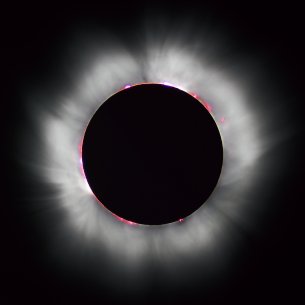
1. Total Eclipse: If the Moon is at the near side of it's orbit, the apparent size of the Moon is larger and hence covers up the entire disk of the Sun for a total solar eclipse.
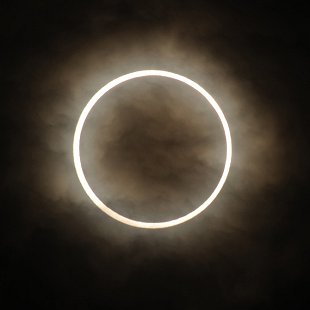
2. Annular Eclipse: If the Moon is at the far side of the orbit around the Earth, the Moon appears smaller and thus does not completely cover up the Sun. In this case, an annular solar eclipse occurs and you will see a bright ring or "annulus" around the Moon (and the Sun's corona will not be visible). Annular eclipses are dangerous to look at with the unprotected eye.
3. Hybrid Eclipse: Hybrid solar eclipses occur when part of the eclipse path results in a total eclipse and another part results in an annular solar eclipse.
4. Partial Eclipse: Partial solar eclipses occur when the Moon only covers up a section of the Sun's disk.