
Can you visit Bayfordbury Observatory? Yes
Ticketed public open evenings Nov-Mar with talks and planetarium, from 5:30 pm; GBP 20 adult, 10 child; book ahead.
A public night at an observatory usually starts at dusk with a short talk, then a line at the eyepiece of the main telescope for the Moon, a planet or a bright cluster, with volunteers' smaller telescopes set up outside. Dress for the night air even in summer: domes are not heated, so the telescope stays at outside temperature. Many nights sell out or cancel for clouds, so check the observatory's site on the day.
Telescopes at Bayfordbury Observatory
60cm CDK, 20" Cass, 3-16" robotic LX200.
How dark the sky is at Bayfordbury Observatory
Bayfordbury Observatory has no Bortle rating in the list yet. The scale below shows what each class looks like.
Sky brightness and class come from the World Atlas of Artificial Night Sky Brightness (Falchi et al. 2016, CC BY-NC 4.0), with natural skyglow added, at the coordinates below. Research telescopes are often sited on mountains above the haze, so the real sky can be darker than the map suggests.
Bayfordbury Observatory among the observatories of England
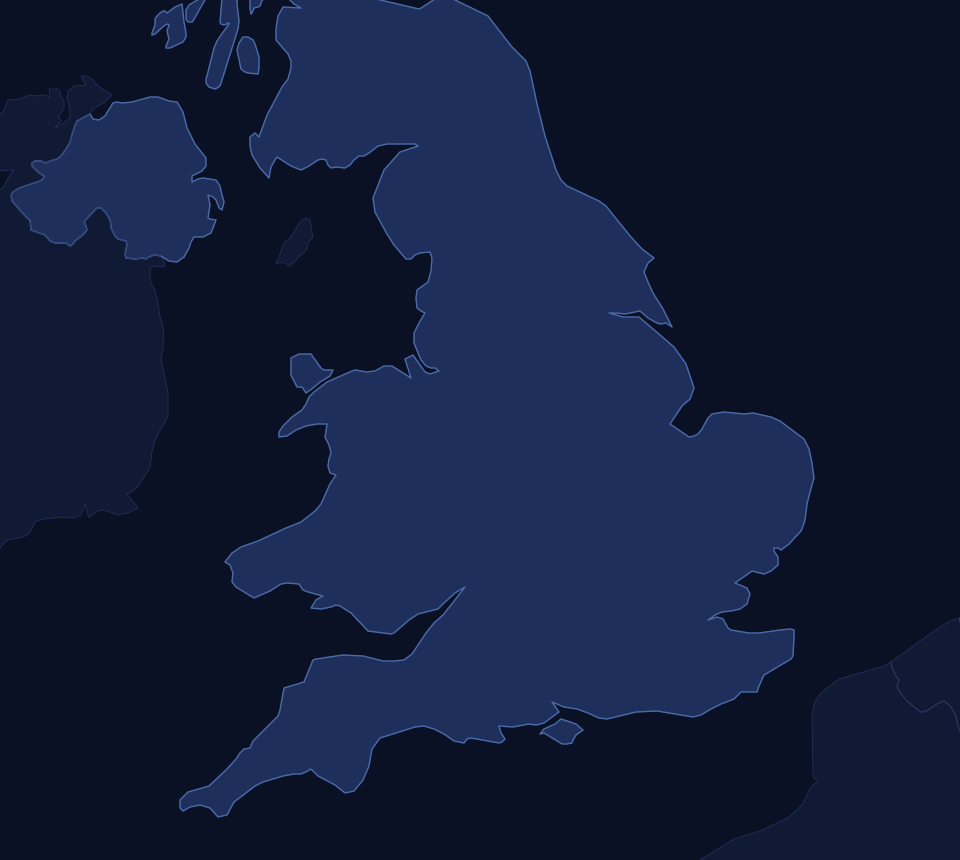
Green dots are observatories open to the public, blue dots research or private sites, squares dark sky places; select one for its page. See Observatories in England for the full list.
The coordinates on this page point to town center of Hertford (approximate; observatory is 3 km SW at Bayfordbury): 51.796°N, 0.079°W.
Map data © OpenStreetMap contributors. Open the larger map · Directions. Mountain observatory roads are often gated after dark; go only on a scheduled public night.
Dark sky places, observatories and clubs near Bayfordbury Observatory
Nearest dark sky places
| Place | Where | Bortle | Distance |
|---|---|---|---|
| Thorington Street, Suffolk | Stoke-by-Nayland, England | 4 | 71 km (44 mi) |
| South Downs International Dark Sky Reserve | Midhurst, England | 4 | 108 km (67 mi) |
| Cranborne Chase | Tollard Royal, England | 4 | 167 km (104 mi) |
| Presteigne and Norton | Presteigne, Wales | 4 | 207 km (129 mi) |
| Peak District National Park | Castleton, England | 4 | 209 km (130 mi) |
| Elan Valley | Rhayader, Wales | 3 | 245 km (152 mi) |
Other observatories open to the public within 150 km
- UCL ObservatoryMill Hill, London, England, 23 km (14 mi). Occasional public open evenings
- Royal Observatory GreenwichGreenwich, London, England, 36 km (22 mi). Museum, Prime Meridian and Peter Harrison Planetarium open daily; ticketed; evening astronomy events
- Cambridge Observatory (Institute of Astronomy)Cambridge, England, 47 km (29 mi). Free public open evenings Wednesdays 7-9 pm, Oct-Mar: talk then telescope viewing if clear
- Aldershot Observatory (Alexander Observatory)Aldershot, Hampshire, England, 76 km (47 mi). Visits by arrangement; occasional Heritage Open Days
- University of Birmingham ObservatoryBirmingham, England, 143 km (89 mi). Public events through Astronomy in the City; ticketed via Eventbrite/TicketTailor
Astronomy clubs within 150 km
- Loughton Astronomical SocietyTheydon Bois, Essex, England, 18 km (11 mi). Meets Thursdays, 8:00 pm
- Letchworth & District Astronomical SocietyLetchworth Garden City, Hertfordshire, England, 23 km (14 mi). Meets Last Wednesday monthly except Dec, 7:30 pm
- Luton Astronomical SocietyLuton, Bedfordshire, England, 25 km (16 mi). Meets Last Thursday monthly except Dec, 7:15 pm
- West of London Astronomical SocietyHarrow, London, England, 30 km (19 mi). Meets Monthly Mondays (no August), 8:00 pm
- Hampstead Scientific SocietyLondon, England, 32 km (20 mi). Meets Hampstead Observatory, Lower Terrace
Star parties near Bayfordbury Observatory
| Star party | Near | Distance | Usual timing |
|---|---|---|---|
| Equinox Sky Camp | Holt, England | 150 km (93 mi) | Near the September equinox |
| AstroCamp | Brecon, Wales | 227 km (141 mi) | Spring and autumn |
| Dalby Forest Starfest | Pickering, England | 278 km (173 mi) | Spring |
| Mayo Dark Sky Festival | Newport, County Mayo | 676 km (420 mi) | Autumn |
Bayfordbury Observatory record
Every value in the observatories dataset for Bayfordbury Observatory
| ID | 141 |
|---|---|
| Name | Bayfordbury Observatory |
| City | Bayfordbury |
| State | Hertfordshire |
| Country | England |
| Continent | Europe |
| Subcontinent | UK |
| Web | https://herts.ac.uk/bayfordbury/bayfordbury-observatory/visit-bayfordbury-observatory/public-open-evenings |
| Public | y |
| Telescope | 60cm CDK, 20" Cass, 3-16" robotic LX200 |
| Lat | 51.79588 |
| Lon | -0.07854 |
| LatLonSpot | town center of Hertford (approximate; observatory is 3 km SW at Bayfordbury) |
| Status | Active |
| StatusNote | University of Hertfordshire teaching observatory |
| PublicNote | Ticketed public open evenings Nov-Mar with talks and planetarium, from 5:30 pm; GBP 20 adult, 10 child; book ahead |
| Sources | https://herts.ac.uk/bayfordbury/bayfordbury-observatory/visit-bayfordbury-observatory/public-open-evenings |
From the site's observatories dataset (observatoriesglobal_q426). Distances are computed from the coordinates.