
Tethys is made almost entirely of water ice
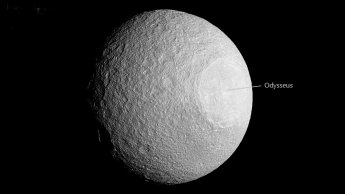
Tethys is 1,062 km across and so low in density that it must be nearly pure water ice. A giant impact basin, Odysseus, is 450 km wide, and a canyon system, Ithaca Chasma, runs about 2,000 km, three-quarters of the way round the moon. Two small moons, Telesto and Calypso, share its orbit, one 60° ahead and one 60° behind.
Tethys surface features on the image
Each number on the image marks one feature.
- Odysseus. One of the largest craters in the solar system for the size of its moon, two-fifths the width of Tethys.
Surface conditions on Tethys
Gravity
0.146 m/s², 1.5% of Earth's
Atmosphere
none
Surface
Odysseus crater; Ithaca Chasma
How to see Tethys
Tethys shines at magnitude 10.2, within reach of a 6-inch telescope near Saturn.
Tethys and its neighbors around Saturn
| Moon | Diameter | Distance | Orbit |
|---|---|---|---|
| Janus | 178.4 km | 151,500 km | 16.7 hours |
| Aegaeon | 0.6 km | 167,500 km | 19.4 hours |
| Mimas | 396.4 km | 186,000 km | 22.6 hours |
| Methone | 2.9 km | 194,700 km | 1.0 days |
| Anthe | 1 km | 198,100 km | 1.0 days |
| Pallene | 4.5 km | 212,300 km | 1.2 days |
| Enceladus | 504.2 km | 238,400 km | 1.4 days |
| Tethys | 1,062.2 km | 295,000 km | 1.9 days |
| Telesto | 24.8 km | 295,000 km | 1.9 days |
| Calypso | 19.2 km | 295,000 km | 1.9 days |
| Helene | 36 km | 377,600 km | 2.7 days |
| Polydeuces | 2.6 km | 377,600 km | 2.7 days |
| Dione | 1,122.8 km | 377,700 km | 2.7 days |
| Rhea | 1,527 km | 527,200 km | 4.5 days |
| Titan | 5,149.5 km | 1.2 million km | 15.9 days |
| 10 more in this group: see all | |||
3 spacecraft have studied Tethys
Voyager 1, Voyager 2, Cassini.
Tethys physical and orbital data
Every value in the moons dataset for Tethys
| Parent | Saturn |
| Group | Major |
| Diameter | 1,062.2 km |
| Distance from planet | 295,000 km |
| Orbital period | 1.887802 days |
| Inclination | 1.1 ° |
| Eccentricity | 0.001 |
| Retrograde orbit | no |
| Magnitude | 10.2 |
| Mass | 6.175 × 10²⁰ kg |
| Density | 0.984 g/cm³ |
| Gravity | 0.146 m/s² |
| Albedo | 0.8 |
| Atmosphere | none |
| Discovered | 1684 |
| Discoverer | G. D. Cassini |
From the site's moons dataset (moons_q426), which follows JPL's satellite tables and lists a source for every row.