
How dark the sky is at Loarre: Bortle Class 3, rural sky
The zenith sky here reads 21.78 magnitudes per square arcsecond. That is about 1.2 times the brightness of a pristine natural sky (22.0), the extra coming from artificial light scattered in the air.
Milky Way
The Milky Way still looks complex overhead, with some light pollution near the horizon
Zodiacal light
Zodiacal light is striking after dusk or before dawn but does not reach far up the sky
Faintest naked-eye stars
Magnitude 6.6 to 7.0 overhead
Naked eye
M33 needs averted vision; globulars M4, M5, M15 and M22 are naked-eye objects
At the eyepiece
Bright galaxies and nebulae show well; the faintest objects lose contrast low in the sky
Sky brightness and class come from the World Atlas of Artificial Night Sky Brightness (Falchi et al. 2016, CC BY-NC 4.0), with natural skyglow added. On the night, haze, smoke, humidity and the Moon set the real limit; see every Bortle Class 3 place.
What's up from Loarre by season
At latitude 42.3°N, the north celestial pole stands 42° above the horizon, close to Polaris. Every star north of declination -48° rises at some time of year. The Milky Way core in Sagittarius climbs to 19° above the southern horizon. These are the constellations well placed, 35° or more above the horizon, at about 10 pm in the middle of each season, brightest first.
January evenings (winter): Auriga, Orion, and Canis Minor
- AurigaOverhead, brightest star Capella
- OrionHigh in the south, brightest star Rigel
- Canis MinorIn the southeast, brightest star Procyon
- TaurusHigh in the southwest, brightest star Aldebaran
- GeminiHigh in the southeast, brightest star Pollux
- Ursa MajorIn the northeast, brightest star Alioth
- PerseusHigh in the west, brightest star Mirfak
- AriesIn the west, brightest star Hamal
Also well placed: Andromeda, Cassiopeia, Triangulum, Lynx, Cancer, Monoceros, Leo Minor, Camelopardalis.
April evenings (spring): Bootes, Virgo, and Leo
- BootesHigh in the east, brightest star Arcturus
- VirgoIn the southeast, brightest star Spica
- LeoHigh in the southwest, brightest star Regulus
- Ursa MajorOverhead, brightest star Alioth
- Ursa MinorIn the north, brightest star Polaris
- Corona BorealisIn the east, brightest star Alphecca
- Canes VenaticiOverhead, brightest star Cor Caroli
- LynxHigh in the northwest, brightest star Alpha Lyncis
Also well placed: Cancer, Leo Minor, Camelopardalis, Coma Berenices, Sextans.
July evenings (summer): Bootes, Lyra, and Aquila
- BootesHigh in the west, brightest star Arcturus
- LyraOverhead, brightest star Vega
- AquilaIn the southeast, brightest star Altair
- CygnusHigh in the east, brightest star Deneb
- Ursa MinorHigh in the north, brightest star Polaris
- OphiuchusIn the south, brightest star Rasalhague
- Corona BorealisHigh in the west, brightest star Alphecca
- DracoHigh in the north, brightest star Eltanin
Also well placed: Cepheus, Hercules, Canes Venatici, Sagitta, Delphinus, Lacerta, Scutum, Vulpecula.
October evenings (fall): Lyra, Cygnus, and Perseus
- LyraIn the west, brightest star Vega
- CygnusHigh in the west, brightest star Deneb
- PerseusIn the northeast, brightest star Mirfak
- AriesIn the east, brightest star Hamal
- AndromedaOverhead, brightest star Alpheratz
- DracoIn the northwest, brightest star Eltanin
- CassiopeiaHigh in the northeast, brightest star Schedar
- PegasusHigh in the southwest, brightest star Enif
Also well placed: Cepheus, Aquarius, Triangulum, Sagitta, Pisces, Delphinus, Lacerta, Equuleus, Camelopardalis, Vulpecula.
Showpieces from Loarre through the year
| Sight | Constellation | January | April | July | October |
|---|---|---|---|---|---|
| Andromeda Galaxy (M31) | Andromeda | In the northwest | - | - | Overhead |
| Orion Nebula (M42) | Orion | In the south | - | - | - |
| Pleiades (M45) | Taurus | High in the southwest | - | - | In the east |
| Double Cluster | Perseus | High in the northwest | - | - | High in the northeast |
| Hercules Cluster (M13) | Hercules | - | In the east | Overhead | - |
| Whirlpool Galaxy (M51) | Canes Venatici | - | High in the northeast | In the northwest | - |
| Ring Nebula (M57) | Lyra | - | - | Overhead | In the west |
At about 10 pm on the 15th of each month; a dash means the sight is below 25° then.
Never set from Loarre
Only skim the southern horizon from Loarre
Never rise from Loarre
Where to set up at Loarre
The coordinates on this page point to Loarre Castle, at 1,070 m (3,510 ft): 42.322°N, 0.607°W.
Map data © OpenStreetMap contributors. Open the larger map · Directions. Arrive before dark, park facing away from other observers, and use red light only.
Loarre among the dark sky places of Spain
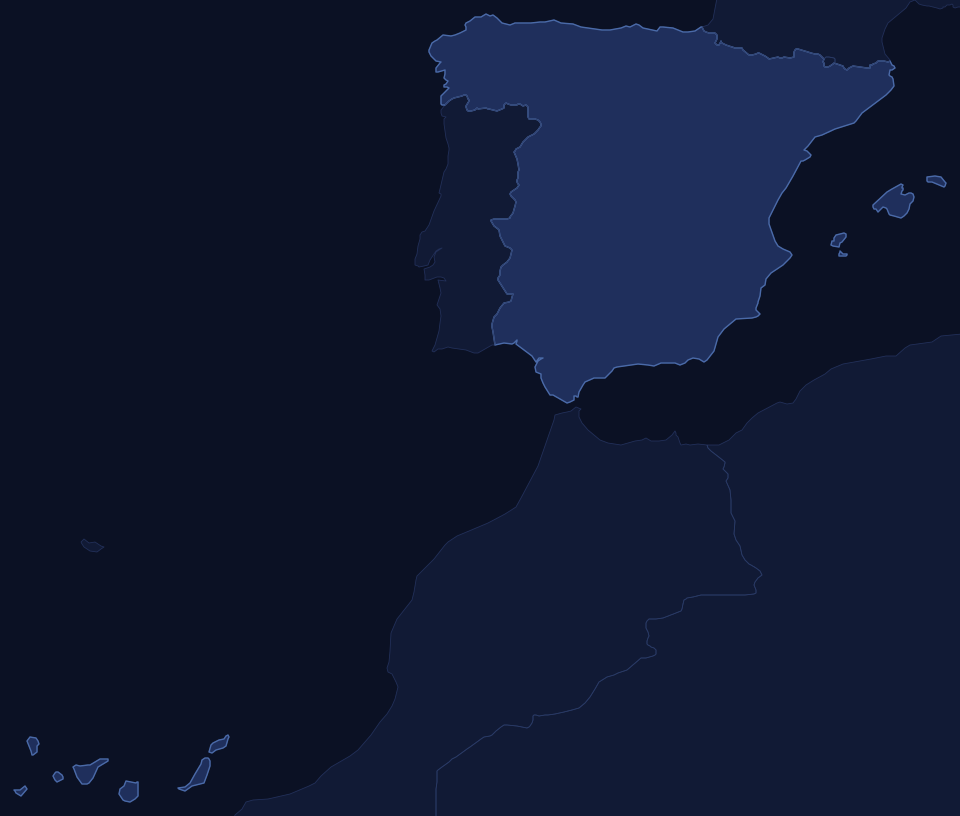
Each dot is a dark sky place, colored by Bortle class; select one for its page. See Dark sky places outside the United States for the full list, darkest first.
Camping and lodging at Loarre
The nearest town with motels or inns is Loarre, Spain. Check the official site for campgrounds and overnight rules; many parks close their gates at night, so ask about after-dark access.
Dark sky places nearest Loarre
| Place | Where | Bortle | Distance |
|---|---|---|---|
| Valle del Roncal | Isaba, Spain | 3 | 66 km (41 mi) |
| Pic du Midi International Dark Sky Reserve | La Mongie, France | 3 | 92 km (57 mi) |
| Montsec Starlight Reserve | Ager, Spain | 3 | 114 km (71 mi) |
| Parc Astronomic Montsec | Ager, Spain | 3 | 116 km (72 mi) |
| La Rioja Starlight Reserve | Spain | 4 | 138 km (86 mi) |
| Muriel Viejo Starlight | Muriel Viejo, Spain | 3 | 146 km (91 mi) |
| Camino Natural Via Verde del Ferrocarril Vasco Navarro | San Millan, Spain | 4 | 161 km (100 mi) |
| Comarca Cuencas Mineras Starlight Reserve | Utrillas, Spain | 4 | 169 km (105 mi) |
Observatories and astronomy clubs near Loarre
Observatories within 100 km
- Pic du Midi ObservatoryBagneres-de-Bigorre, Occitanie, France, 92 km (57 mi), open to the public
Nearest astronomy clubs
- Agrupacion Astronomica AragonesaZaragoza, Spain, 77 km (48 mi)
See observatories and astronomy clubs around the world. Local clubs often hold their star parties at dark sky places like this one.
Loarre record
Every value in the dark sky places dataset for Loarre
| Park | 237 |
|---|---|
| Name | Loarre |
| Area | Europe |
| Region | Huesca |
| Country | Spain |
| Location | Loarre |
| Lat | 42.32200 |
| Lon | -0.60720 |
| LatLonSpot | Loarre Castle |
| Elevation_m | 1070 |
| LandManager | Government of Aragon |
| Status | Open |
| Lodging | Loarre, Spain |
| Sources | https://latitude.to/articles-by-country/es/spain/38255/loarre-castle |
| Bortle | 3 |
| SQM | 21.78 |
From the site's dark sky places dataset (darkparksglobal_q426). The sky by season is computed from the coordinates.