
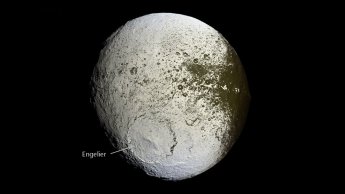
Iapetus has one coal-black hemisphere and one bright as snow
Iapetus, 1,469 km across, is two-toned: its leading hemisphere is as dark as coal and its trailing one bright white. Dark dust swept up from Saturn's outer moons coats the leading side, which then warms, drives off its ice and darkens further. A ridge up to 20 km high runs along much of its equator, giving it a walnut shape. Giovanni Cassini found it in 1671 and noticed it was only visible on one side of Saturn.
Iapetus surface features on the image
Each number on the image marks one feature.
- Cassini Regio. The hemisphere facing forward in its orbit is coated with dark dust swept up from Saturn's outer moon Phoebe. Dark ice warms in sunlight and loses its frost, so the dark side grows darker.
- Bright trailing side. The other hemisphere is clean water ice. Giovanni Cassini noticed in 1671 that Iapetus could only be seen on one side of Saturn.
- Equatorial ridge. A ridge running along the equator, seen here as a bump on the right edge, unlike anything on other moons. Its origin is still debated.
Surface conditions on Iapetus
Gravity
0.224 m/s², 2.3% of Earth's
Atmosphere
none
Surface
two-tone surface; equatorial ridge
How to see Iapetus
You can see the two faces from your backyard: Iapetus is about magnitude 10.2 when west of Saturn, showing its bright side, and 11.9 when east, showing its dark side. It orbits in 79 days and swings up to 9′ from the planet.
Iapetus and its neighbors around Saturn
| Moon | Diameter | Distance | Orbit |
|---|---|---|---|
| Mimas | 396.4 km | 186,000 km | 22.6 hours |
| Methone | 2.9 km | 194,700 km | 1.0 days |
| Anthe | 1 km | 198,100 km | 1.0 days |
| Pallene | 4.5 km | 212,300 km | 1.2 days |
| Enceladus | 504.2 km | 238,400 km | 1.4 days |
| Tethys | 1,062.2 km | 295,000 km | 1.9 days |
| Telesto | 24.8 km | 295,000 km | 1.9 days |
| Calypso | 19.2 km | 295,000 km | 1.9 days |
| Helene | 36 km | 377,600 km | 2.7 days |
| Polydeuces | 2.6 km | 377,600 km | 2.7 days |
| Dione | 1,122.8 km | 377,700 km | 2.7 days |
| Rhea | 1,527 km | 527,200 km | 4.5 days |
| Titan | 5,149.5 km | 1.2 million km | 15.9 days |
| Hyperion | 270 km | 1.5 million km | 21.3 days |
| Iapetus | 1,468.6 km | 3.6 million km | 79.3 days |
| 10 more in this group: see all | |||
3 spacecraft have studied Iapetus
Voyager 1, Voyager 2, Cassini.
Iapetus physical and orbital data
Every value in the moons dataset for Iapetus
| Parent | Saturn |
| Group | Major |
| Diameter | 1,468.6 km |
| Distance from planet | 3.5617e+06 km |
| Orbital period | 79.331002 days |
| Inclination | 7.6 ° |
| Eccentricity | 0.028 |
| Retrograde orbit | no |
| Magnitude | 11 |
| Mass | 1.8057 × 10²¹ kg |
| Density | 1.0887 g/cm³ |
| Gravity | 0.224 m/s² |
| Atmosphere | none |
| Discovered | 1671 |
| Discoverer | G. D. Cassini |
From the site's moons dataset (moons_q426), which follows JPL's satellite tables and lists a source for every row.