
How dark the sky is at Taroona: Bortle Class 4, rural and suburban transition
The zenith sky here reads 21.15 magnitudes per square arcsecond. That is about 2.2 times the brightness of a pristine natural sky (22.0), the extra coming from artificial light scattered in the air.
Milky Way
The Milky Way is impressive well above the horizon but loses its fine detail
Zodiacal light
Zodiacal light is visible but faint
Faintest naked-eye stars
Magnitude 6.1 to 6.5 overhead
Naked eye
Light domes from towns show in several directions; M33 is hard even with averted vision
At the eyepiece
Clusters, planetary nebulae and bright galaxies are fine; faint nebulae need a filter
Sky brightness and class come from the World Atlas of Artificial Night Sky Brightness (Falchi et al. 2016, CC BY-NC 4.0), with natural skyglow added. On the night, haze, smoke, humidity and the Moon set the real limit.
What's up from Taroona by season
At latitude 42.9°S, the south celestial pole stands 43° above the horizon. Every star south of declination +47° rises at some time of year. The Milky Way core in Sagittarius climbs to 76° above the northern horizon. These are the constellations well placed, 35° or more above the horizon, at about 10 pm in the middle of each season, brightest first.
January evenings (summer): Canis Major, Carina, and Orion
- Canis MajorHigh in the northeast, brightest star Sirius
- CarinaHigh in the southeast, brightest star Canopus
- OrionIn the north, brightest star Rigel
- EridanusHigh in the northwest, brightest star Achernar
- VelaHigh in the southeast, brightest star Gamma Velorum
- HydraIn the east, brightest star Alphard
- PuppisHigh in the east, brightest star Naos
- PhoenixIn the southwest, brightest star Ankaa
Also well placed: Lepus, Columba, Musca, Hydrus, Tucana, Pictor, Dorado, Reticulum, Pyxis, Octans, Monoceros, Volans, Horologium, Fornax, Chamaeleon, Antlia, Caelum, Mensa.
April evenings (fall): Carina, Centaurus, and Crux
- CarinaHigh in the southwest, brightest star Canopus
- CentaurusOverhead, brightest star Alpha Centauri
- CruxOverhead, brightest star Acrux
- VirgoIn the northeast, brightest star Spica
- VelaHigh in the west, brightest star Gamma Velorum
- Triangulum AustraleIn the southeast, brightest star Atria
- HydraIn the northwest, brightest star Alphard
- PuppisIn the west, brightest star Naos
Also well placed: Lupus, Corvus, Libra, Musca, Ara, Circinus, Dorado, Crater, Pyxis, Octans, Volans, Apus, Norma, Chamaeleon, Antlia, Sextans, Mensa.
July evenings (winter): Centaurus, Aquila, and Crux
- CentaurusIn the southwest, brightest star Alpha Centauri
- AquilaIn the northeast, brightest star Altair
- CruxIn the southwest, brightest star Acrux
- ScorpiusOverhead, brightest star Antares
- GrusIn the southeast, brightest star Alnair
- SagittariusHigh in the northeast, brightest star Kaus Australis
- Triangulum AustraleHigh in the south, brightest star Atria
- PavoHigh in the southeast, brightest star Peacock
Also well placed: Ophiuchus, Lupus, Libra, Serpens, Musca, Ara, Capricornus, Tucana, Indus, Circinus, Telescopium, Octans, Apus, Scutum, Norma, Chamaeleon, Corona Australis, Microscopium.
October evenings (spring): Piscis Austrinus, Grus, and Sagittarius
- Piscis AustrinusOverhead, brightest star Fomalhaut
- GrusOverhead, brightest star Alnair
- SagittariusIn the west, brightest star Kaus Australis
- PavoIn the southwest, brightest star Peacock
- CetusIn the northeast, brightest star Diphda
- PhoenixOverhead, brightest star Ankaa
- HydrusHigh in the south, brightest star Beta Hydri
- CapricornusIn the northwest, brightest star Deneb Algedi
Also well placed: Tucana, Aquarius, Indus, Dorado, Reticulum, Telescopium, Octans, Apus, Fornax, Horologium, Corona Australis, Sculptor, Microscopium, Mensa.
Showpieces from Taroona through the year
| Sight | Constellation | January | April | July | October |
|---|---|---|---|---|---|
| Orion Nebula (M42) | Orion | High in the north | - | - | - |
| Southern Cross | Crux | In the southeast | Overhead | In the southwest | - |
| Carina Nebula | Carina | In the southeast | Overhead | In the southwest | - |
| Large Magellanic Cloud | Dorado | High in the south | In the southwest | - | In the southeast |
| 47 Tucanae | Tucana | In the southwest | In the south | In the south | High in the south |
| Omega Centauri | Centaurus | - | High in the southeast | In the southwest | - |
| Milky Way core | Sagittarius | - | - | Overhead | - |
| Lagoon Nebula (M8) | Sagittarius | - | - | Overhead | - |
At about 10 pm on the 15th of each month; a dash means the sight is below 25° then.
Never set from Taroona
- Apus
- Ara
- Carina
- Chamaeleon
- Circinus
- Crux
- Dorado
- Horologium
- Hydrus
- Indus
- Mensa
- Musca
- Norma
- Octans
- Pavo
- Pictor
- Reticulum
- Telescopium
- Triangulum Australe
- Tucana
- Volans
Only skim the northern horizon from Taroona
Never rise from Taroona
Where to set up at Taroona
The coordinates on this page point to Taroona suburb center, at 50 m (160 ft): 42.948°S, 147.349°E.
Map data © OpenStreetMap contributors. Open the larger map · Directions. Arrive before dark, park facing away from other observers, and use red light only.
Taroona among the dark sky places of Australia
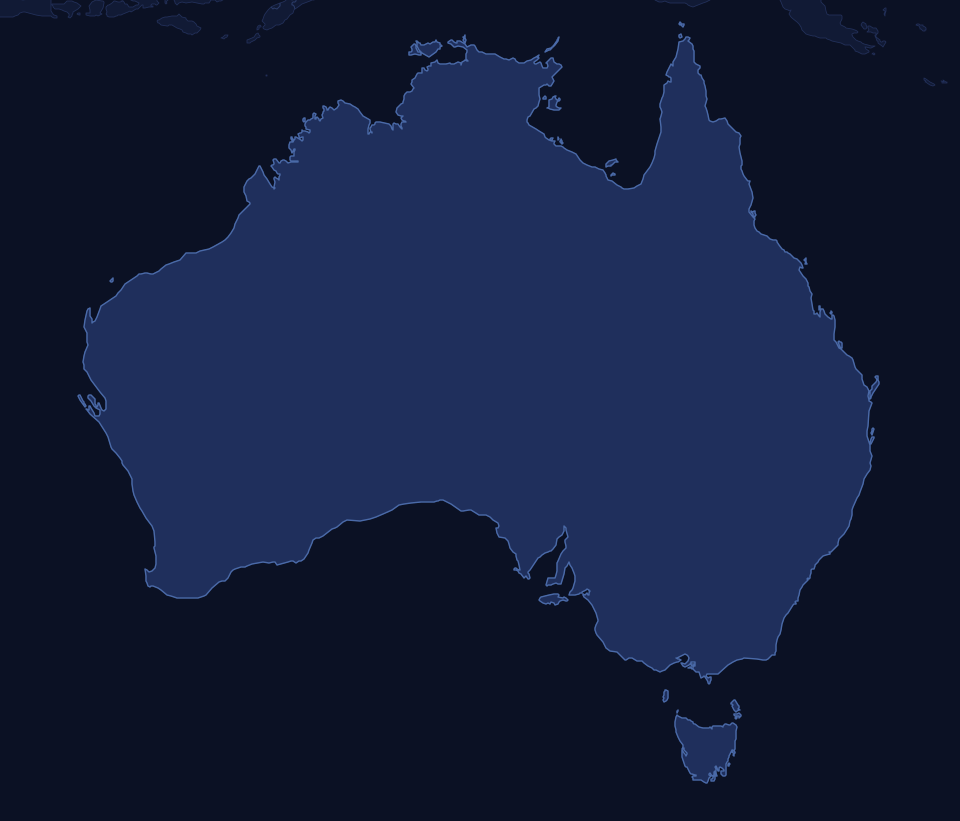
Each dot is a dark sky place, colored by Bortle class; select one for its page. Diamonds are star parties. See Dark sky places in Australia for the full list, darkest first.
Camping and lodging at Taroona
The nearest town with motels or inns is Hobart, TAS. Check the official site for campgrounds and overnight rules; many parks close their gates at night, so ask about after-dark access.
Dark sky places nearest Taroona
| Place | Where | Bortle | Distance |
|---|---|---|---|
| Snake Valley Observatory | Snake Valley, Australia | 2 | 674 km (419 mi) |
| Barrenjoey Headland | Palm Beach, Australia | 4 | 1,098 km (682 mi) |
| Carrickalinga Dark Sky Community | Carrickalinga, Australia | 3 | 1,140 km (708 mi) |
| River Murray Dark Sky Reserve | Swan Reach, Australia | 2 | 1,148 km (714 mi) |
| Warrumbungle National Park | Coonabarabran, Australia | 1 | 1,305 km (811 mi) |
| Arkaroola Dark Sky Sanctuary | Arkaroola Village, Australia | 1 | 1,575 km (979 mi) |
| Rakiura Stewart Island Dark Sky Sanctuary | Oban, New Zealand | 1 | 1,689 km (1,049 mi) |
| T?huna Glenorchy | Glenorchy, New Zealand | 1 | 1,693 km (1,052 mi) |
Observatories inside Taroona, and astronomy clubs nearby
- Mount Pleasant Radio ObservatoryOpen to the public. Grote Reber museum on site; several open days a year
Observatories within 100 km
- Greenhill ObservatorySpring Hill, Tasmania, Australia, 58 km (36 mi), research observatory
Nearest astronomy clubs
- Astronomical Society of TasmaniaHobart, Tasmania, Australia, 8 km (5 mi). Meets Monthly meetings in Hobart; venue on society website
See observatories and astronomy clubs around the world. Local clubs often hold their star parties at dark sky places like this one.
Taroona record
Every value in the dark sky places dataset for Taroona
| Park | 12 |
|---|---|
| Name | Taroona |
| Area | Oceania |
| Region | Tasmania |
| Country | Australia |
| Location | Hobart |
| URL | https://www.darkskytasmania.org/dark-sky-sanctuary |
| Lat | -42.94806 |
| Lon | 147.34889 |
| LatLonSpot | Taroona suburb center |
| Elevation_m | 50 |
| LandManager | Kingborough Council |
| Status | Open |
| StatusNote | Hobart suburb; not a DarkSky place; seed URL could not be verified |
| Lodging | Hobart, TAS |
| Sources | https://en.wikipedia.org/wiki/Taroona |
| Bortle | 4 |
| SQM | 21.15 |
From the site's dark sky places dataset (darkparksglobal_q426). The sky by season is computed from the coordinates.