
How dark the sky is at Dwingelderveld National Park: Bortle Class 4, rural and suburban transition
The zenith sky here reads 21.30 magnitudes per square arcsecond. That is about 1.9 times the brightness of a pristine natural sky (22.0), the extra coming from artificial light scattered in the air.
Milky Way
The Milky Way is impressive well above the horizon but loses its fine detail
Zodiacal light
Zodiacal light is visible but faint
Faintest naked-eye stars
Magnitude 6.1 to 6.5 overhead
Naked eye
Light domes from towns show in several directions; M33 is hard even with averted vision
At the eyepiece
Clusters, planetary nebulae and bright galaxies are fine; faint nebulae need a filter
Sky brightness and class come from the World Atlas of Artificial Night Sky Brightness (Falchi et al. 2016, CC BY-NC 4.0), with natural skyglow added. On the night, haze, smoke, humidity and the Moon set the real limit.
What's up from Dwingelderveld National Park by season
At latitude 52.8°N, the north celestial pole stands 53° above the horizon, close to Polaris. Every star north of declination -37° rises at some time of year. The Milky Way core in Sagittarius climbs to 8° above the southern horizon. These are the constellations well placed, 35° or more above the horizon, at about 10 pm in the middle of each season, brightest first.
January evenings (winter): Auriga, Orion, and Canis Minor
- AurigaOverhead, brightest star Capella
- OrionIn the south, brightest star Rigel
- Canis MinorIn the southeast, brightest star Procyon
- TaurusIn the southwest, brightest star Aldebaran
- GeminiHigh in the southeast, brightest star Pollux
- Ursa MajorHigh in the northeast, brightest star Alioth
- PerseusHigh in the west, brightest star Mirfak
- Ursa MinorIn the north, brightest star Polaris
Also well placed: Aries, Andromeda, Cassiopeia, Cepheus, Triangulum, Lynx, Cancer, Leo Minor, Camelopardalis.
April evenings (spring): Bootes, Leo, and Ursa Major
- BootesIn the east, brightest star Arcturus
- LeoIn the southwest, brightest star Regulus
- Ursa MajorOverhead, brightest star Alioth
- Ursa MinorHigh in the north, brightest star Polaris
- Corona BorealisIn the east, brightest star Alphecca
- DracoIn the northeast, brightest star Eltanin
- Canes VenaticiOverhead, brightest star Cor Caroli
- LynxHigh in the west, brightest star Alpha Lyncis
Also well placed: Cancer, Leo Minor, Camelopardalis, Coma Berenices.
July evenings (summer): Bootes, Lyra, and Cygnus
- BootesHigh in the west, brightest star Arcturus
- LyraHigh in the southeast, brightest star Vega
- CygnusHigh in the east, brightest star Deneb
- Ursa MinorHigh in the north, brightest star Polaris
- Corona BorealisHigh in the southwest, brightest star Alphecca
- DracoOverhead, brightest star Eltanin
- CassiopeiaIn the northeast, brightest star Schedar
- CepheusHigh in the northeast, brightest star Alderamin
Also well placed: Hercules, Canes Venatici, Sagitta, Delphinus, Lacerta, Vulpecula.
October evenings (fall): Lyra, Cygnus, and Perseus
- LyraIn the west, brightest star Vega
- CygnusHigh in the west, brightest star Deneb
- PerseusHigh in the east, brightest star Mirfak
- Ursa MinorIn the north, brightest star Polaris
- AriesIn the southeast, brightest star Hamal
- AndromedaOverhead, brightest star Alpheratz
- DracoIn the northwest, brightest star Eltanin
- CassiopeiaOverhead, brightest star Schedar
Also well placed: Pegasus, Cepheus, Triangulum, Pisces, Delphinus, Lacerta, Equuleus, Camelopardalis, Vulpecula.
Showpieces from Dwingelderveld National Park through the year
| Sight | Constellation | January | April | July | October |
|---|---|---|---|---|---|
| Andromeda Galaxy (M31) | Andromeda | In the west | - | - | Overhead |
| Orion Nebula (M42) | Orion | In the south | - | - | - |
| Pleiades (M45) | Taurus | High in the southwest | - | - | In the east |
| Double Cluster | Perseus | High in the northwest | In the northwest | In the northeast | High in the northeast |
| Hercules Cluster (M13) | Hercules | - | In the east | Overhead | - |
| Whirlpool Galaxy (M51) | Canes Venatici | - | Overhead | High in the west | - |
| Ring Nebula (M57) | Lyra | - | - | High in the southeast | In the west |
At about 10 pm on the 15th of each month; a dash means the sight is below 25° then.
Never set from Dwingelderveld National Park
- Andromeda
- Auriga
- Camelopardalis
- Canes Venatici
- Cassiopeia
- Cepheus
- Cygnus
- Draco
- Lacerta
- Lynx
- Perseus
- Ursa Major
- Ursa Minor
Only skim the southern horizon from Dwingelderveld National Park
Never rise from Dwingelderveld National Park
Where to set up at Dwingelderveld National Park
The coordinates on this page point to park center (Wikipedia infobox point), at 15 m (50 ft): 52.803°N, 6.399°E.
Map data © OpenStreetMap contributors. Open the larger map · Directions. Arrive before dark, park facing away from other observers, and use red light only.
Dwingelderveld National Park among the dark sky places of Netherlands
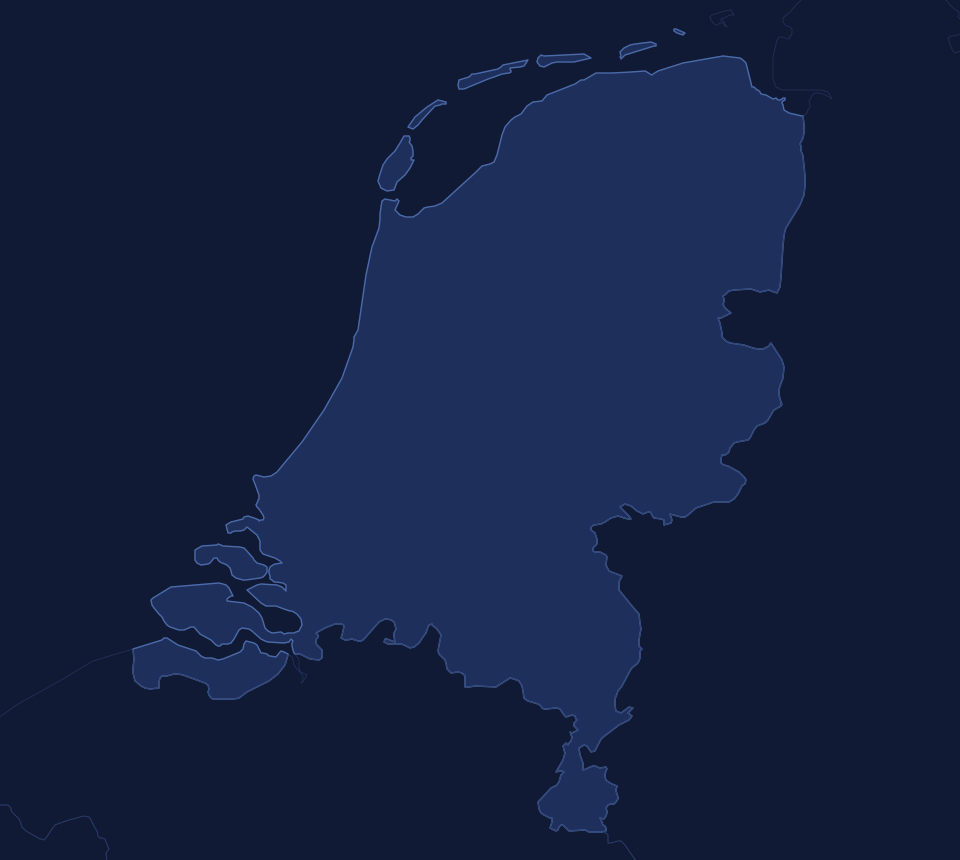
Each dot is a dark sky place, colored by Bortle class; select one for its page. See Dark sky places outside the United States for the full list, darkest first.
Camping and lodging at Dwingelderveld National Park
The nearest town with motels or inns is Dwingeloo, Netherlands. Check the official site for campgrounds and overnight rules; many parks close their gates at night, so ask about after-dark access.
Dark sky places nearest Dwingelderveld National Park
| Place | Where | Bortle | Distance |
|---|---|---|---|
| Sint Jansklooster - De Wieden | Sint Jansklooster, Netherlands | 5 | 30 km (19 mi) |
| Lauwersmeer National Park | Lauwersoog, Netherlands | 4 | 66 km (41 mi) |
| De Hoge Veluwe National Park | Otterlo, Netherlands | 4 | 90 km (56 mi) |
| Veluwezoom National Park | Rheden, Netherlands | 4 | 91 km (56 mi) |
| De Boschplaat | Terschelling, Netherlands | 3 | 93 km (58 mi) |
| ARTIS Park | Amsterdam, Netherlands | 7 | 111 km (69 mi) |
| Spiekeroog Star Island | Spiekeroog, Germany | 3 | 138 km (86 mi) |
| Gulpen | Gulpen, Netherlands | 5 | 223 km (139 mi) |
Star parties near Dwingelderveld National Park
| Star party | Near | Distance | Usual timing |
|---|---|---|---|
| Equinox Sky Camp | Holt, England | 354 km (220 mi) | Near the September equinox |
| Dalby Forest Starfest | Pickering, England | 495 km (308 mi) | Spring |
| AstroCamp | Brecon, Wales | 671 km (417 mi) | Spring and autumn |
Observatories inside Dwingelderveld National Park, and astronomy clubs nearby
- Dwingeloo Radio ObservatoryResearch observatory. Exterior visitable; occasional open days (Sterrendag Dwingeloo)
- Westerbork Synthesis Radio TelescopeResearch observatory. Research site; dishes viewable from public roads
Nearest astronomy clubs
- Astronomischer Verein der Grafschaft Bentheim e.V.Neuenhaus, Germany, 51 km (32 mi). Meets 1st Monday monthly, 8 pm (next Monday if holiday)
- Sternwarte Papenburg e.V.Papenburg, Germany, 74 km (46 mi). Meets Sternwarte Papenburg, Bethlehem rechts 51b (former glassworks)
- Sternfreunde Borken e.V.Borken, Germany, 111 km (69 mi). Meets Josef-Bresser-Sternwarte, Hoxfeld
- Astronomie Club OstfrieslandWiesmoor, Germany, 112 km (70 mi)
- KNVWS (Royal Netherlands Association for Meteorology and Astronomy)Utrecht, Netherlands, 117 km (73 mi)
See observatories and astronomy clubs around the world. Local clubs often hold their star parties at dark sky places like this one.
Dwingelderveld National Park record
Every value in the dark sky places dataset for Dwingelderveld National Park
| Park | 173 |
|---|---|
| Name | Dwingelderveld National Park |
| Area | Europe |
| Region | Drenthe |
| Country | Netherlands |
| Location | Dwingeloo |
| Lat | 52.80300 |
| Lon | 6.39900 |
| LatLonSpot | park center (Wikipedia infobox point) |
| Elevation_m | 15 |
| LandManager | Staatsbosbeheer and Natuurmonumenten |
| Status | Open |
| Lodging | Dwingeloo, Netherlands |
| Sources | https://en.wikipedia.org/wiki/Dwingelderveld_National_Park |
| Bortle | 4 |
| SQM | 21.30 |
From the site's dark sky places dataset (darkparksglobal_q426). The sky by season is computed from the coordinates.